
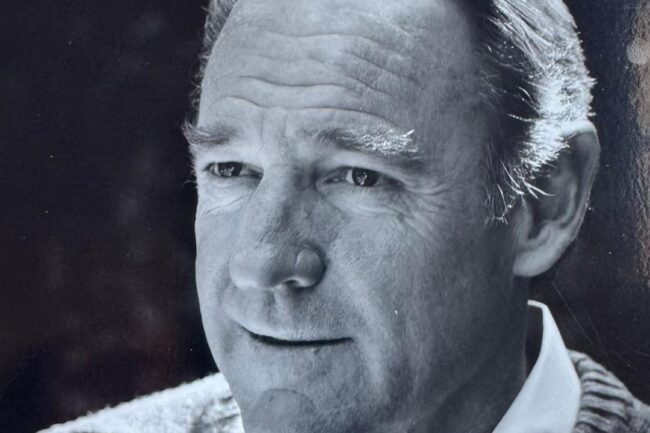
 I first met John Walton at his home in Carmel in 2011 to interview him for an audio tour project I was producing, which illuminated the story of the City of Los Angeles’ Owens Valley water grab in the early twentieth century from the perspective of a historical expert on the subject. John, a sociologist and Professor at UC Davis, had written one of the definitive texts on these events in his 1992 Western Times and Water Wars (UC Press), along with William Kahrl’s 1982 Water and Power (UC Press). Both are included on two tracks on There It Is—Take It!
John was kind and soft-spoken, with a light in his eyes that showed his dedication to the subjects of his research. These events, stories and subjects remained animated in the present and drove his active support and essays defending the communities he cared about or called home. I worked with John over the following years on projects related to the Los Angeles Aqueduct. I included his essay titled “Film as Urban History: The Case of Chinatown” in an online journal I co-edited called ARID (link here).
John’s continued interest in the interplay of social history (events) and cultural history (stories) meant that he stayed informed about current issues in the communities he had written about, maintaining lifelong connections to those still fighting against the exploitation of Owens Valley or a similar urban water grab attempted by Las Vegas in eastern Nevada.
Last November, I hosted a public dialogue event to commemorate the 1924 occupation of Alabama Gates by Owens Valley residents in Lone Pine, CA. John was the keynote speaker. He was scheduled to be in conversation with Bill Kahrl, who sadly passed away last August. In Bill’s place, a conversation took place between him and Dr. Sophia Borgias (Boise State University), a human-environment geographer whose research focuses on Owens Valley Indigenous water rights. John felt very happy to speak and meet with community activists who continue to fight to protect Owens Valley.
I feel grateful to have collaborated with John, Bill, and the other scholars who have authored these important historical records of this momentous and consequential chapter of California history.
JOHN THOMAS WALTON
September 22, 1937 – July 1, 2025
John Thomas Walton, an author and distinguished sociologist emeritus, educator, and devoted family man, passed away peacefully on July 1, 2025, at his home in Carmel Valley, CA, surrounded by his loving family. He is survived by his wife of nearly 63 years, Priscilla; his daughter, Casey; son-in-law, Eric; and his cherished grandchildren, Mia and Aidan.
Born in 1937 in Los Angeles, CA, John was the middle of three sons born to Delvy Thomas Walton and Florence Higgins. His two brothers, Craig and Laurence predeceased him. He grew up in Westwood near UCLA and graduated from the UCLA Elementary School. This became the beginning of a long association with the University of California system.
He took great pride in being a native of Los Angeles. Its history was deeply meaningful to him and would later inspire one of his most significant works on California’s water and land issues. The spirit of 1940s and ’50s of Los Angeles permeated his life.
John earned a bachelor’s degree in psychology from California State University, Northridge, where his passion for understanding human behavior and social structures blossomed. He was later awarded a NIMH Grant and completed the CSU Northridge Sociology Master’s program, where he fused his interest in culture, politics and history with his deep desire to effect social change.
It was in 1958 at CSU Northridge when John met Priscilla Helm, a fellow sociology student with whom he a shared passion for social activism and justice. After her Peace Corps service in Peru, they married on Sept. 8, 1963, in Encino, CA and became lifelong partners in both life and the pursuit of social justice.
After completing his Ph.D. in sociology at the University of California, Santa Barbara in 1966, John joined the sociology faculty at Northwestern University in Evanston, Illinois, where he taught from 1966 to 1978. He often fondly referred to these years as the “glory days” of academic freedom and exploration. It was also during this period that John and Priscilla welcomed their daughter, Casey, into the world.
The harsh Midwest winters prompted John in 1978 to accept a faculty position in the Sociology Department at the University of California, Davis, where he would remain for the next 26 years. He served as a senior faculty member and as Department Chair. He was widely admired for his ability to inspire students and his unwavering commitment to their education. While at UC Davis, John wrote “Western Times and Water Wars: State, Culture and Rebellion” (1992) chronicling the social history of the Owens Valley.
During their years at UC Davis, John and Pris became regular visitors to the Monterey Peninsula. It was during this time that John continued his interest in the interplay of social history (events) and cultural history (stories).
The narratives about the era of California missions and Monterey’s Cannery Row and the writings of John Steinbeck and Robinson Jeffers propelled him to write “Storied Land: Community and Memory in Monterey” (2001). In this book he examined the historical formation and reformation of community in Monterey over a period of 230 years.
John and Priscilla retired in the Carmel Valley, a place that held great personal meaning for them. There, John continued to serve his community through support of organizations like the Big Sur Land Trust, Land Watch Monterey County, the Carmel Valley Association, the Owens Valley Committee and Friends of Hopkins Marine Station in Pacific Grove. His final book (2015), “The Legendary Detective: A History of the Business of Being a Private Detective,” examined the true history of private detectives, contrasting it with their portrayal in popular culture. It has recently been translated into Spanish and issued as a paperback edition.
John’s legacy as a scholar, mentor and compassionate human being will be deeply missed by all who knew him. He was gentle, kind, empathetic and always sought to uplift those around him, regardless of their background or station in life. He valued hard work, honesty and the pursuit of knowledge. Whether through his academic work, personal relationships, or community service, John’s impact will resonate for years to come.
A Celebration of Life will be held in John Walton’s honor from 4 to 6 p.m. on Sept. 21, 2025, at Hidden Valley Music Seminars, 104 Carmel Valley Road, Carmel Valley.